
Radical Hope in the Face of State Violence from Letters to the Housed by Paul Asplund of SecondGrace.LA
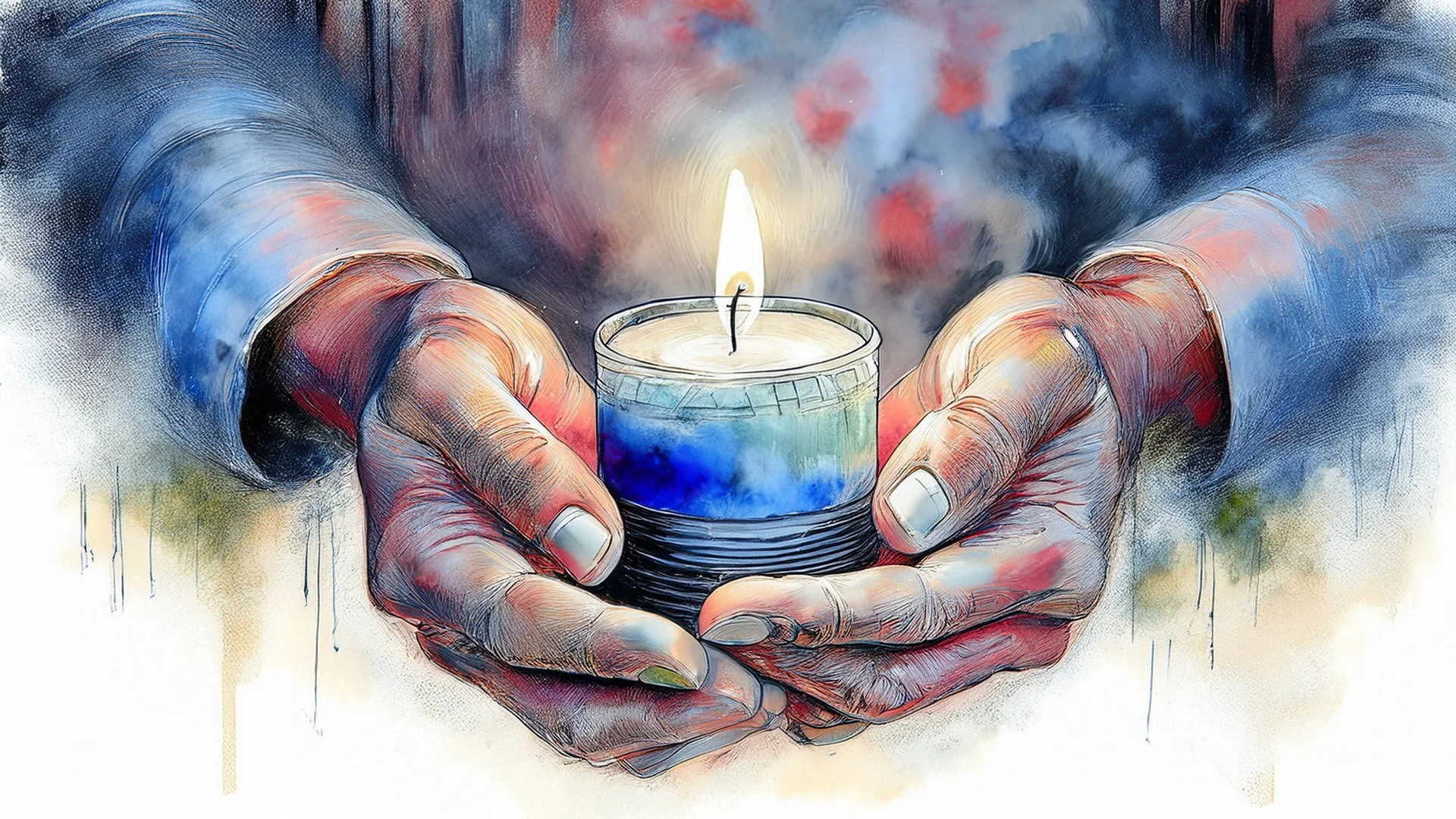
That's where hope lives—not in institutions or policies, but in the small practices of care we maintain for each other when everything else collapses. Illustration by Delux Multimedia
Hello Readers,
I know I promised to start wrapping up the series on the New Department of Homelessness and Housing, but the news from my home state continues to be dire. Here's where I am after another week of watching everything unfold.
The Occupation
We're almost two months into this mess. Three thousand armed federal agents continue to occupy Minnesota. Masked ICE and Border Patrol agents are conducting warrantless home invasions with battering rams, detaining US citizens based on their appearance or accent, and using tear gas and pepper balls against peaceful observers. Renee Good's murder by an ICE agent in my old neighborhood was immediately labeled by federal officials as justified before any investigation began. Now schools have gone into lockdown. Businesses have closed. 1,500 Army paratroopers from Alaska are on alert for possible deployment.
Immigrants are sheltering in place or sprinting home from bus stops, while home security cameras capture men being taken from bus shelters by masked agents in unmarked vehicles. This is not law enforcement. This is state terror, deployed against the most vulnerable among us to train the rest of us in compliance.
I know this pattern. I was raised inside it.
My Father's Code
My father was a Special Agent with the IRS during the Civil Rights era, before Nixon created the DEA and ATF. His job was mostly investigative, but it came with extraordinary power because he had the authority to walk into your home or business and seize everything, leaving you homeless or without means to support your family. He struggled with these decisions. His code was always forgiveness and understanding first, before bringing the weight of his department down on someone. He modeled justice for me.
Before I was born, he and my mother were stationed in Oklahoma City. He worked out of the federal building there, his territory covering states in the Deep South. He saw lynchings, prostitution rings, human trafficking, the Klan. He learned to hate white southerners and told us never to go south of the Mason-Dixon Line. "There's no one, and nothing worth a damn down there," he would say.
Justice, he believed, was in the north where we were.
Then the farm crisis came. Rural Minnesota's economy collapsed. The Posse Comitatus movement grew, defining the local Sheriff as the highest law of the land. My dad, being a "revenuer," became a target. We had police escorts to school. Our front windows were shot out. Those were tense times. My dad refused a transfer to a safer town. We limited our outings to church, school, and grocery shopping.
Even with all the violence and threats against our family, my dad supported the farmers. It was the John Birchers who escalated the conspiracy talk and fomented the first racism I was ever exposed to. In those days, there were only white people within 100 miles of home, so I didn't really know what they were on about. Years later, when I realized I was gay, I understood they meant people like me too.
What Broke Him
What broke my dad's spirit was the Pine Ridge incident in the early '70s. Two of his friends in the FBI were killed. He was devastated. He had been in communication with them regularly about this operation. The risks they were taking troubled him. My dad also knew many First Nations people from his service in Korea. Some of them from the Fond du Lac reservation near where he grew up were friends since childhood, and it was common to find them around our dining table sharing a beer. When the investigation started, my dad was compelled to give a false statement about the allegation that FBI agents were planting weapons inside the Pine Ridge reservation—something he knew they were doing. Something he had warned them not to do.
Soon after, he quit his job and started to drink harder, and in that state told us the truth about what had happened.
I was starting to learn that northerners were no more just and moral than anyone, except for my dad.
This was one of many times after the 1960s that the public lost faith in the Federal Government—something unimaginable to my dad before Pine Ridge broke him. That faith has never returned, and for good reason. Once enough of the public was ready to accept the criminality of its own government, the stories multiplied.
I was at the age when I started forming my own opinions. Even with all the knowledge I've accumulated since about the world, I remain essentially as I was in my teens: hopeful and curious.
Hope as Practice
This is what I mean when I talk about hope as practice rather than feeling. It's not optimism that looks away from the battering rams and the bus stop arrests. It's not pretending Minnesota is an aberration that will be corrected by good people acting in good faith. It's looking directly at all of it—at Renee Good's killing, at men taken from bus shelters in unmarked vehicles—and still choosing engagement over withdrawal. It's muscular. It requires something from me.
Yesterday I rewatched Errol Morris's film I Am Not Your Negro, built from James Baldwin's unfinished manuscript about the murders of Medgar Evers, Malcolm X, and Martin Luther King Jr. Baldwin understood what America is capable of better than anyone I know. He watched the corpses of his brothers and sisters pile up. He saw Dorothy Counts being reviled and spat upon as she walked to school. He knew that when a Black man says "Give me liberty or give me death," the entire white world judges him a criminal, while celebrating the same words from any white man's mouth.
"I can't be a pessimist, because I'm alive. To be a pessimist means you have agreed that human life is an academic matter, so I'm forced to be an optimist. I am forced to believe that we can survive whatever we must survive."— James Baldwin
Baldwin maintained this stance while looking directly at American brutality, never once turning away from the truth of what this country does to Black people, Indigenous people, immigrants, queer people—all of us the state has marked as disposable.
Lessons from Ai Weiwei
This morning I read Ai Weiwei's essay on leaving Germany and returning to China. He writes about understanding that all governments are essentially authoritarian, that societies governed by regulations but lacking individual moral judgment are more dangerous than those with none at all. He's teaching us to be realistic about power, about the quiet logic of authoritarianism that emerges when people stop questioning, when conversation becomes avoidance, when we believe we live in a free society simply because we're told we do.
"Freedom is not a gift. It must be wrestled from the hands of banality and the quiet complicity with power."— Ai Weiwei
He's right. And this wrestling requires seeing clearly that no government is coming to save us, that institutional power operates through brutality whether we acknowledge it or not, and that our response must come from somewhere else entirely.
The Test Lab
Then I saw a video by Paul Niculita, a Romanian actor who recently went viral defending the American working class. He pushes back against the easy contempt many feel toward poor white Americans, reminding us that "America has been the test lab" for everything now spreading globally—addictive pharmaceuticals, weaponized debt, engineered identity wars, entertainment as sedation. "What you're witnessing in the collapse of trust, the social chaos, the inability to distinguish truth from manipulation, isn't because the people have failed," he says. "It's because the people have been systematically broken and then blamed for it."
This is crucial for understanding Minnesota. The 3,000 federal agents occupying that state aren't rogue actors. They're products of the same machinery that's been systematically breaking American communities for generations. Many of those agents believe they're doing the right thing. They've been trained into compliance with state violence, just as we've all been trained to look away from it.
"Do we abandon them? Do we mock them? Or do we finally recognize that behind the opioid crisis, the obesity, the division and the rage is a population in mourning—mourning the death of its sovereignty, its family structures, and its purpose?"— Paul Niculita
We need to maintain this complexity. The agents conducting raids in Minnesota are both perpetrators of violence and products of the same system crushing all of us. The Trump administration deploying them is exercising state power exactly as every American administration has—through domination and terror—while also being a symptom of a population that's lost faith in every institution that once promised care.
We don't have to choose between seeing the violence clearly and maintaining compassion for how we all got here.
So What Now?
The same thing that made my father a decent man and a good cop: forgiveness and understanding.
These were the most powerful tools he had for enforcing the law. He was able to help hundreds of people who he could have destroyed. People within arm's reach.
Support Minnesota
In Minnesota right now, the ACLU of Minnesota is coordinating legal observers and filing lawsuits to protect constitutional rights. The Immigrant Law Center of Minnesota provides emergency legal support. Communities United Against Police Brutality trains observers and documents abuses. Local bail funds and sanctuary networks are mobilizing daily. United We Dream and the National Immigration Law Center are coordinating national response. Know Your Rights hotlines are running 24/7.
Support them:
Support Los Angeles
Here in Los Angeles, it means showing up for the work that's already happening. At SELAH, we serve unhoused neighbors including undocumented families, domestic violence survivors, and LGBTQIA+ community members who know state violence intimately. The LA Community Action Network, CHIRLA (Coalition for Humane Immigrant Rights), and the People's City Council are building mutual aid networks that function regardless of what the state does.
Support them:
These aren't perfect organizations. None of us are. But they're doing the work within arm's reach—building sanctuary networks, training legal observers, coordinating rapid response teams, providing direct support to families being targeted. They need volunteers, donations, and people willing to show up when ICE shows up.
If You Can't Donate
If you can't volunteer or donate, you can still act. Document ICE activity in your neighborhood like the Minneapolis residents recording bus stop arrests. Learn your rights and your neighbors' rights at the Immigrant Defense Project or United We Dream's hotlines. Challenge your elected officials. Refuse cooperation with warrantless searches. Check on your neighbors.
"Not everything that is faced can be changed, but nothing can be changed until it is faced."— James Baldwin
Minnesota is facing it right now. The rest of us need to be ready. Because as Baldwin also knew, this isn't a Minnesota problem or a border problem or an immigration problem. This is what America does. This is what it's always done. The only question is whether we're going to keep pretending otherwise, or whether we're going to practice the kind of hope that requires something from us.
Where Hope Lives
I believe in the inherent goodness of people and communities. I believe there is something that counters entropy, that organizes rather than scatters, that empowers rather than enervates. I've seen it in recovery communities, in homeless encampments, in immigrant mutual aid networks, in the neighbors who sprint home from bus stops and still show up for each other the next day.
That's where hope lives—not in institutions or policies or the best of America's nature, but in the small practices of care we maintain for each other when everything else collapses.
So respond locally. Help the people within arm's reach. Build networks that can hold each other when the state shows up with battering rams. Practice hospitality without waiting for permission or funding or the right conditions.
Because we're alive, and alive means we have to try.
In love and service,
Paul