
Public Housing Pays Back
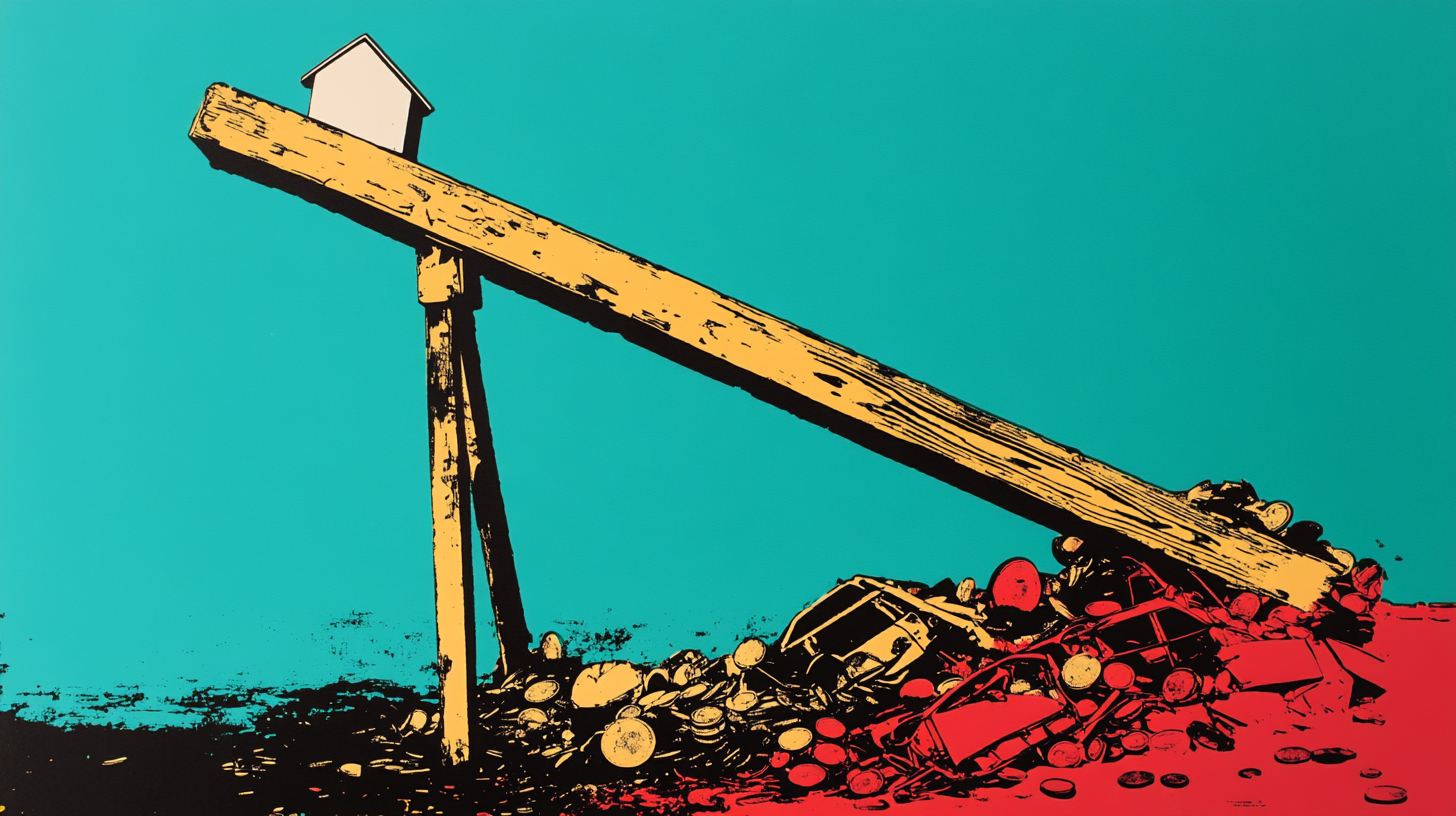
Keeping people housed is the least expensive way to stop homelessness from growing. We know this. We keep not doing it. Visual by deluxmultimedia
Staying Housed · Part 3 of 4
Letters to the Housed by Paul Asplund | June 16, 2026
Public Housing Pays Back Nearly $3 On Every Dollar Spent
When we talk about defunding public housing as a budget decision, we're hiding the real question: who pays instead, and how much more?
A new study out of Toronto's public housing system landed on my desk last week, and I'm excited to share its central findings. The research, from the Canadian Centre for Economic Analysis (CANCEA), modeled five different investment scenarios for public housing across a 25-year period and measured what each scenario actually produced: in housing units, in resident health, in economic output, and in downstream costs to healthcare and social systems. And while the numbers are Canadian, the logic is universal.
The real cost of doing nothing
This is what the study found when it modeled the scenario closest to what many North American cities are actually doing right now: reducing investment in existing public housing stock, letting deferred maintenance accumulate, allowing buildings to deteriorate.
Under that reduced-funding pathway, cumulative social value over 25 years turns negative. Negative $8.8 billion in the Toronto region alone. The benefit-cost ratio of underinvestment comes out to -0.08. For every dollar saved on the front end by not maintaining housing, more than a dollar is lost on the back end in healthcare burden, justice system costs, homelessness-related services, and economic drag.
By 2050, under the reduced-funding scenario, more than 67% of residents in public housing are projected to be in poor or very poor health. Under the combined renewal-and-construction pathway, that number drops to 12%.
That is the human cost of a budget decision, rendered in health outcomes over time.
The study also tracked what happens to people who were meant to be served by a shrinking system but weren't: 139 building closures, 13,322 units lost, roughly 6,000 fewer people housed than at the start of the period. Those people don't disappear. They move into the healthcare system, the justice system, emergency shelters, and the street. The study quantifies the downstream cost: $1.2 billion in additional burden on public systems relative to status quo funding.
Saving money on housing doesn't save money. It just moves the bill downstream.
What this has to do with Los Angeles
Los Angeles is not Toronto. Our housing crisis is more severe, our investment gaps are wider, and we are operating in a federal funding environment that has been actively hostile to public housing for the better part of a year. The Continuum of Care received over $220 million from HUD in FY 2024. That funding stream is now under active threat. The math we're running in LA starts from a much harder baseline than the one modeled in this study.
But the structural argument translates directly. When we treat public housing as a line item to cut rather than infrastructure to maintain, we don't make the problem smaller. We make it more expensive, more diffuse, and harder to solve. The cost shows up later, in ER visits and encampment clearings and emergency shelter contracts and the years it takes a person to rebuild after extended housing instability. None of those costs get counted in the original budget decision.
In LA, it now costs between $700,000 and $800,000 to build a single one-bedroom unit of affordable housing. The Homekey+ program, which converts existing motels and hotels, brings that cost down to around $144,000 per unit — which is still significant, but a fraction of new construction. The math of building our way out is brutal. The math of maintaining what we have, or of failing to maintain what we have, is the conversation we need to be having.
Keeping people in their housing is the least expensive, most effective way to stop homelessness from growing. We know this. We keep not doing it.
This week in Los Angeles, as the city struggles to clear sidewalks and enforce ordinances near fan zones, the same city faces a nearly $1 billion general fund shortfall. Mayor Bass has acknowledged there is no general fund money available for additional housing supports. LA County is navigating a $4 billion settlement while trying to maintain services. The federal funding environment has shifted in ways that will take years to fully understand.
These are real constraints, and they are also the conditions under which every future budget decision will be made. The Toronto research gives us a framework for understanding what different choices will actually cost over time.
The investment that pays for itself
The same study modeled what happens under the strongest investment pathway: combining renewal of existing stock with new construction. The results are striking.
The combined pathway generates a benefit-cost ratio of 2.80, meaning that every dollar invested produces $2.80 in measurable return across social value, economic output, and avoided system burden.
It supports 354,500 cumulative job-years. It reduces healthcare burden by $1.5 billion relative to status quo funding and avoids 524,000 hospital inpatient days. It generates nearly $50 billion in cumulative GDP. And it results in 4,700 fewer people experiencing homelessness by 2050 compared to simply maintaining current funding levels.
That last number when extrapolated for LA lands at roughly 23,000 fewer people experiencing homelessness by 2050. Not because of the scale, but because of what it tells us about the direction of the choice. Current funding produces a certain number of people housed and a certain number not housed. Reduced funding produces more people not housed. Stronger investment produces fewer. These are not mysterious outcomes. They are predictable, and they have been modeled.
Public housing investment, the study argues, is not a social protection expenditure in the traditional sense. It is economic infrastructure. It generates employment. It reduces downstream public costs. It produces social value that can be monetized and compared against the cost of the investment. When we frame the question as "can we afford public housing," we are asking it backwards. The more accurate question is what we can afford not to invest in, and what happens to the people and systems that absorb the difference. (A recent Canadian analysis offers a useful benchmark for what that investment could return, which we've detailed in an editor's note below.)
What the World Cup teaches us about this
I am writing this in the middle of the World Cup and the city is buzzing in the way only LA can when something global and beautiful is happening here. We know how to put on a show and I don't begrudge that. I have genuine affection for what this city can become when it decides to show the world something. But the next few weeks will teach us where our services to our unhoused neighbors succeeded and failed. We have less than 18 months before LA2028 overwhelms us with even more visitors and I've written about my dreams, my Radical Hope, for what LA could be. Can become.
But the same city that mobilized extraordinary resources to prepare for these eight matches has, for years, been unable to mobilize the political will to maintain and expand its public housing infrastructure.
The Toronto study offers something useful for thinking about what comes next: a 25-year frame. What are the choices we make today, and what do they cost in 2050? If we reduce investment in existing housing stock, the bill comes due in health outcomes, in lost units, in greater burden on every other public system. If we combine renewal with expansion, the investment returns more than it costs.
This is the math nobody wants to face, because the results require a kind of honesty about the present that is uncomfortable. We are, right now, choosing the more expensive path. We are letting deferred maintenance accumulate in existing affordable units. We are struggling to fund the replacement of federal dollars that are being withdrawn and thousands more people than necessary are experiencing homelessness because of investment decisions already made.
Radical Hope doesn't ask us to pretend these choices are good ones. It asks us to see them clearly, name them honestly, and keep working toward something different. I've written about the social housing successes in Vienna and other cities who have run the experiment and published the results. The only question is whether we decide the numbers matter.
Next week: the final piece in the Staying Housed series. What does accountability look like from a housed neighbor's perspective, in a city that just showed the world its best face?
Until then,
Paul
Editor's note
The benefit-cost figures cited in this article are drawn from the Public Housing Dividend Report, released June 1, 2026, by the Canadian Centre for Economic Analysis (CANCEA) and commissioned by the GTHA Community Housing Collaborative, with support from Scotiabank. The report models five public housing investment scenarios for the Greater Toronto and Hamilton Area through 2050. The GTHA has a population of roughly 8.3 million and an estimated 15,400 people experiencing homelessness in Toronto proper. LA County has a population of approximately 10 million and roughly 75,000 people experiencing homelessness — which is nearly five times Toronto's figure. A direct proportional scaling of the report's optimal investment scenario to LA County's homeless population would suggest healthcare savings in the range of $4 to $6 billion, GDP impact exceeding $85 billion, and a benefit-cost ratio at or above 2.80, given that avoided costs per homeless person (emergency healthcare, criminal justice, shelter) are substantially higher in California than in Ontario. These figures are projections, not guarantees, and assume a level of sustained public investment that does not currently exist in Los Angeles. The full report is available at gthachc.ca.
Sources
Canadian Centre for Economic Analysis (CANCEA), The Public Housing Dividend: Social and Economic Impacts of Public Housing in the GTHA, April 2026
LA County general fund shortfall: Mayor Bass budget remarks, 2026
Homekey+ cost per unit: California Department of Housing and Community Development
LA County HUD Continuum of Care funding: LAHSA, FY 2024 funding summary
LA affordable housing construction costs ($700K–$800K per unit): LAist, 2026 housing cost reporting
Paul Asplund is the founder of Second Grace LA and author of Letters to the Housed, published weekly at secondgracela.substack.com. His work focuses on ending homelessness through community building and systemic change.
Letters to the Housed | secondgracela.substack.com | SecondGrace.LA
Production & deployment by Delux Multimedia