
A Different Road to the Same Destination
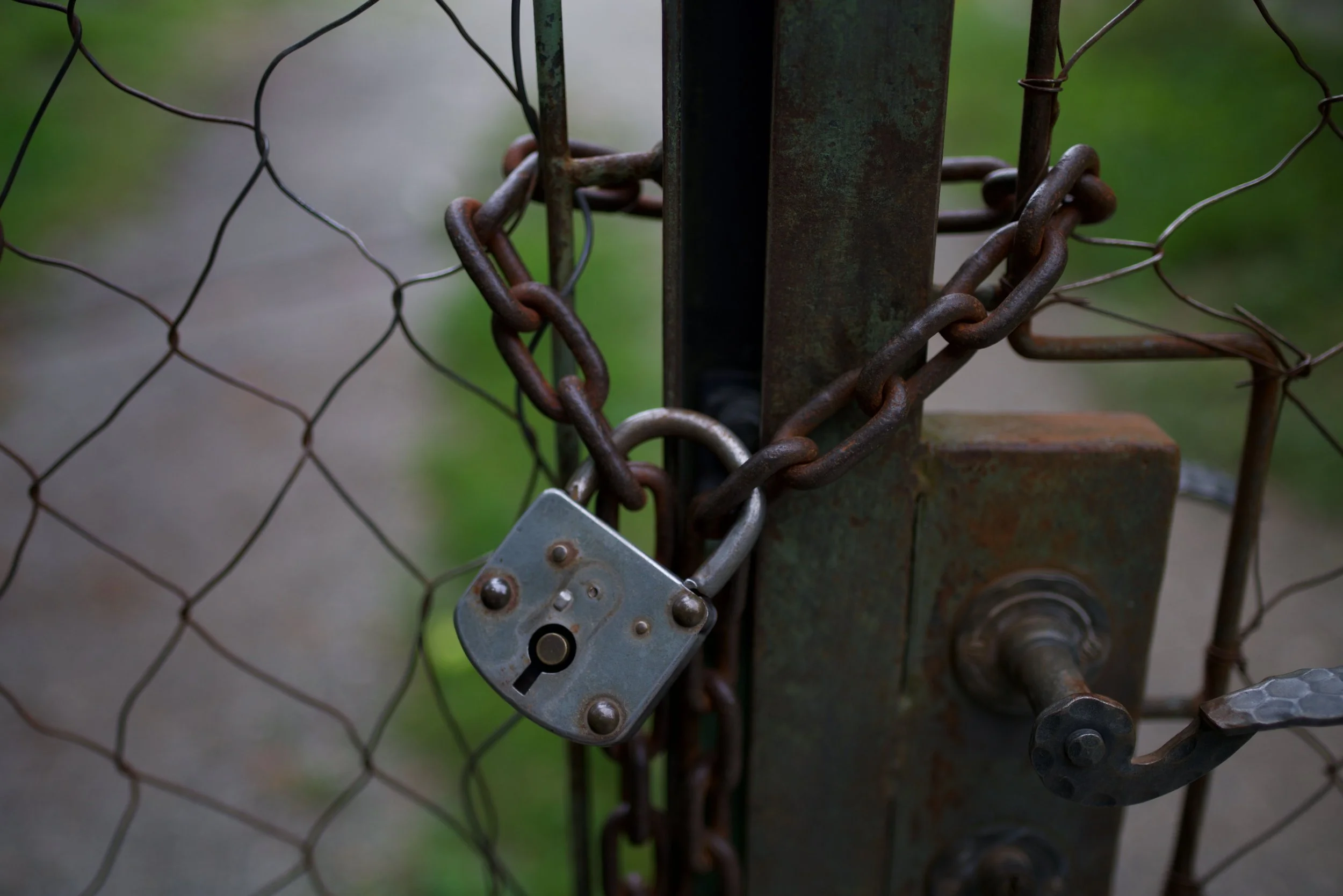
The lock doesn't know which road got you here. Photo by Andreas Schnabl
HUD's suspension of LAHSA's funding looks different from the ESG approach. The people losing housing won't notice the distinction.
Letters to the Housed | June 30, 2026
On June 11, the day the FIFA World Cup opened in Los Angeles, the U.S. Department of Housing and Urban Development suspended all federal funding to the Los Angeles Homeless Services Authority. The letter, sent to LAHSA board chair Wendy Greuel and CEO Gita O'Neill, accused the agency of "wanton mismanagement" and a "clear pattern of fraud," and gave LAHSA 30 days to request a hearing or see the suspension become permanent.
The timing was not subtle. The city was hosting the world and the encampments that remained near fan zones were already drawing international attention. The federal government chose that moment to cut off the primary pass-through agency for almost $200 million in annual HUD homelessness funding to LA County.
In May I wrote about HUD's plan to issue a new Continuum of Care Notice of Funding Opportunity and the administration's parallel proposal to eliminate the CoC program entirely and replace it with an expanded Emergency Solutions Grant. I predicted that the ESG approach would be the mechanism they'd use to block the money. I was wrong about the mechanism. I was not wrong about the destination.
What I Expected, and What Happened Instead
The ESG approach was ideological. It required the administration to argue that Housing First doesn't work, that transitional housing and sobriety requirements should replace permanent supportive housing, and that the community oversight boards that govern CoC spending are "unaccountable." Courts blocked it twice. The 1st Circuit denied the administration's appeal. The legal footing was soft because the argument was policy preference dressed as regulatory authority, and judges could see the difference.
The fraud approach is procedural. Suspending federal funding to a specific recipient for documented mismanagement is well within HUD's existing authority under federal procurement regulations. There is no obvious litigation hook of the kind that stopped the NOFO. LAHSA has 30 days to request a hearing, and it has said it will contest the suspension, but the path for challenging a fraud-based administrative action is considerably narrower than the path for challenging a policy-motivated rule change.
The administration also made a shrewder political choice this time. To argue against Housing First, HUD had to take on the entire evidence base for permanent supportive housing and the advocacy community that defends it. To argue against LAHSA specifically, HUD could cite a federal judge who described "obvious fraud" after LAHSA renewed a contract for an 88-bed shelter operating at half capacity; a November 2024 audit by LA City Controller Kenneth Mejia finding $513 million in unspent homelessness funding. Those documents were produced by local officials, not federal ones. The LA County Board of Supervisors had already stripped LAHSA of $300 million and hundreds of workers in April 2025, creating a new county-run department in its place.
"The administration did not create LAHSA's accountability problems. It found them already well documented, and used them."
Why the Distinction Matters, and Why It Doesn't
Why It Matters
It matters because the legal and political landscape is different. The courts that blocked the ESG swap may not be able to block this one on the same grounds. Advocates and local officials who were united against an ideological attack on Housing First are more divided when the target is an agency they themselves have criticized. The administration has chosen a path that is harder to fight and easier to defend.
There is one structural dimension that has gotten less attention in the coverage. As CityWatch LA noted this week, HUD's suspension doesn't just freeze LAHSA's operating budget. Because LAHSA is the pass-through for federal CoC funds that flow to the city and county and then back to LAHSA through service agreements, the suspension effectively cuts off federal money to the city and county's own homelessness programs as well. The circle of exposure is wider than LAHSA's balance sheet.
Why It Doesn't
Even so, it doesn't matter at all to the people whose housing depends on this funding.
LAHSA is a pass-through agency. The federal dollars don't stay at LAHSA. They flow through LAHSA to dozens of subgrantee nonprofits running permanent supportive housing programs, rapid rehousing placements, street outreach teams, and transitional housing sites across the county. Those subgrantees use the money to pay landlords, to fund case managers, to keep leases intact for people who worked hard to get housed and are trying to stay that way.
When that funding freezes, the subgrantees don't stop needing to pay rent. Landlords don't suspend leases pending an inspector general investigation. The people currently housed through these programs are not parties to the dispute between HUD and LAHSA. They are the collateral consequence of it.
"LAHSA deserved accountability. The people it housed deserved protection. Those two things are not in conflict. The administration chose one and not the other."
LAHSA's own statement said the action "could put thousands of formerly homeless people back on the street." It remains unclear, as of this writing, exactly how many millions will be withheld during the suspension period, how quickly subgrantees will feel the shortfall, or whether emergency alternative funding can be assembled fast enough to prevent lease terminations. That uncertainty is itself a crisis for organizations operating on thin margins with no reserve capacity.
The Accountability Argument Deserves a Serious Answer
LAHSA's failures are widely known and well documented. An agency that could not determine in August 2023 whether it was paying for empty hotel rooms because it failed to track when residents left transitional housing is not an agency that has earned unqualified trust. An agency that could not produce documentation for nearly 2,300 housing sites for which it was responsible has a documentation problem. An agency that fabricated certifications to cover up the absence of conflict-of-interest policies until late in 2025 has a governance problem. These are not minor administrative irregularities.
The accountability argument also deserves a structural answer. LAHSA is a joint city-county creation that was designed to coordinate funding across two governments with different priorities, different timelines, and different political pressures. The governance problems that produced the accountability failures are partly the result of that structure. The LA County Board recognized this when it created the new Department of Homeless Services and Housing. Mayor Bass recognized it when she directed the city to evaluate bypassing LAHSA entirely. The restructuring was already underway. The question worth asking is whether a funding suspension that destabilizes the people currently being served accelerates a better outcome or simply produces more people on the street during a transition that was already happening.
What Comes Next
LAHSA has said it will contest the suspension. The 30-day clock started June 11. A hearing, if granted, does not automatically restore funding; it creates a process. In the meantime, subgrantee organizations are making decisions about staffing, about how long they can continue operations without a guaranteed funding stream, about whether to start giving notice to landlords before they have to.
The disruption arrives at the worst possible moment for LAHSA's own staff. Today, June 30, 284 workers reach their last day of employment, the final consequence of LA County's April 2025 decision to pull more than $300 million in annual funding and transfer those programs to the new County Department of Homeless Services and Housing. LAHSA has until July 11 to formally request a hearing to contest the federal suspension. Whether or not that request is filed, the county restructuring and the federal freeze are landing simultaneously, leaving subgrantee organizations to navigate two major funding transitions at once, with no buffer and no clear timeline for resolution.
The administration's stated next step is for the HUD inspector general to conduct "a thorough investigation." The Homelessness Fraud and Corruption Task Force, formed by First Assistant U.S. Attorney Bill Essayli in April 2025, is also investigating LAHSA's finances through a parallel criminal inquiry. The outcome of those investigations will determine whether the fraud allegations are true and justify the suspension, or whether the suspension was a political instrument that took advantage of the ongoing troubles.
California's state government, the county's new homeless services department, and the city are each evaluating what emergency funding mechanisms exist to bridge a gap that nobody had budgeted for. Measure A funds are not immediately interchangeable with federal CoC dollars. HHAP is already committed. The general fund shortfall is already $1 billion. The shuffling of funding sources I described earlier this month has limits, and those limits are now being tested in real time.
The mechanisms matter, and so does the frame. In May I wrote that the CoC fight was no longer just a homelessness story, that it had become a separation of powers story. This development is something slightly different. It is a story about what happens when an institution that genuinely needed reform becomes the target of an administration that would have found a reason to cut the funding regardless of the reform. Those two things can be true simultaneously, and the people whose housing is at stake don't have the luxury of sorting out which one is driving the outcome.
In May I predicted that HUD would use the ESG mechanism to cut the money. They found a better tool.
"The money is cut either way."
The question now is how many people lose their housing before the legal, political, and fiscal responses catch up, and whether the restructuring that was already underway can be accelerated enough to limit the damage.
I don't have an answer to that question. I'm not sure anyone does yet.
More soon.
Paul
Sources
HUD halts federal homeless dollars to LAHSA, citing mismanagement — LAist, June 11, 2026
Federal funding for LAHSA suspended over "failures" — NBC Los Angeles, June 11, 2026
HUD pulls federal funding from Los Angeles County Homeless Services Authority — CBS Los Angeles, June 11, 2026
RAND LA LEADS 2025 Annual Report — Annual Trends Among the Unsheltered in Three Los Angeles Neighborhoods
Is This the End of LAHSA? — CityWatch LA, June 22, 2026
Prior coverage: They're Coming Back for the CoC. This Time, They Mean It. — Letters to the Housed, May 19, 2026